Telling Real Blood Pressure From Measurement Noise
Detecting artifacts in intensive care blood pressure monitoring. Built for the Intensive Care course in the Clinical Technology bachelor at TU Delft, as a group project.
An arterial line measures blood pressure continuously, and a bedside monitor alarms when that pressure leaves a safe range. The catch is that the line is a piece of physical equipment. Flushing it, an air bubble in the tubing, a transducer hanging at the wrong height, all of these move the number without anything happening to the patient.
The result is an alarm that is not about the patient. That is not a minor annoyance in an intensive care unit: it costs attention, and repeated false alarms are exactly how staff learn to stop reacting to them.
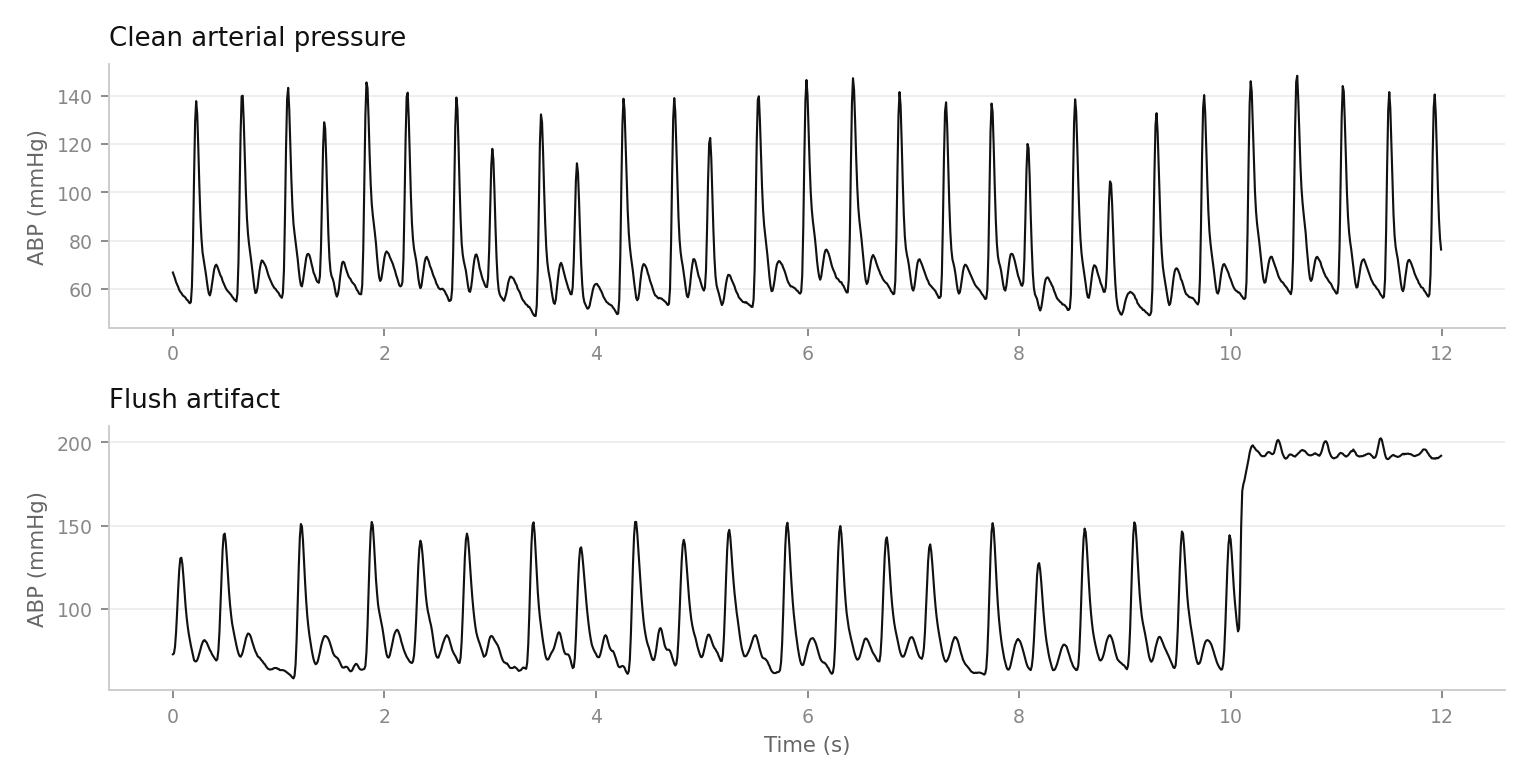
Once you see the two next to each other, the shape of the problem is obvious. A flush does not look like blood pressure. It has no pulse in it, it arrives faster than any physiological change, and it holds a flat, noisy plateau. Every artifact type has a signature like this.
We built detection per artifact type rather than one general classifier: calibration, flush, air bubble, infusion on the central venous line, pendulum motion and transducer height each got their own module, built around the signature that distinguishes it.
On top of that sits a decision tree classifier on features extracted from the signal. The reason for a decision tree rather than something more powerful is the same reason as in my other clinical work: a clinician can read why the algorithm decided something, and a black box that flags an alarm as false is not a tool anyone should trust at a bedside.